

ACTIVITY AREAS
Cloud Computing
Cloud computing has to do with the on-demand delivery and use of IT resources, when needed (such as servers, storage, databases, networking, software, analytics and intelligence). This is done using the Internet (the Cloud), with pricing based on consumption. Rather than purchase, own and maintain data centers or physical servers, you can access technology services, such as computing, storage and database capacity, as per your effective needs.
CLOUD COMPUTING
Types of Cloud Computing
ELFO has developed expertise and experience with the design, configuration and management of advanced cloud services, whether private (private cloud) or public (public cloud) or hybrid (hybrid cloud). In particular, it is on hybrid and public clouds that it expresses its skills at their best:
- Because many companies still need to integrate existing on-premise systems;
- Because, as a Microsoft Solutions Partner for Azure technologies, it guarantees cloud computing expertise certified to the highest standards.
Our experience has shown that, beyond a software solution provider, our clients often find ELFO to be a trusted consulting partner for their cloud journey.

CLOUD COMPUTING
Customer Benefits
ELFO creates cloud computing solutions tailored to the specific needs of each company. This guarantees its customers rapid innovation, flexible resources and economies of scale.
Thus the customer:
- Pays only for the cloud services used and saves operating costs
- Uses the infrastructure more efficiently
Scales resources according to the evolution of business needs.

CLOUD COMPUTING
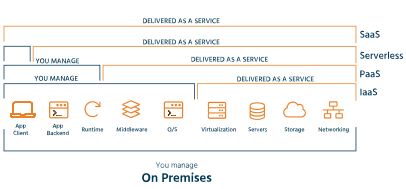
Types of Cloud Computing Services
CLOUD COMPUTING
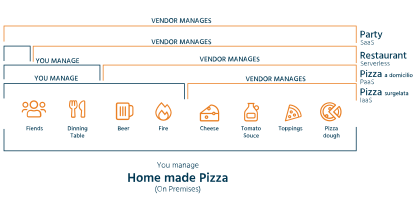
... if they were a pizza
Frequently Asked Questions (FAQ)
Cloud computing highlights
What is cloud computing and how does it benefit an industrial company?
Cloud computing is the on-demand delivery of IT resources over the Internet: compute, storage, and applications billed only for actual consumption. For an industrial company it removes upfront hardware investment, enables access from the office, the plant floor, or the road, and scales capacity in weeks rather than months. As a Microsoft Cloud Platform Gold Partner, ELFO designs Azure-based architectures, both public and hybrid, integrated with the on-premise systems already running in your environment.
SaaS vs on-premise: which is better for industrial software?
Neither model is universally better: SaaS lowers time-to-value and eliminates infrastructure management, while on-premise gives maximum control over data residency and legacy integration. The practical answer depends on data sensitivity, existing ERP landscape, and IT staffing. Companies in manufacturing, food processing and medical devices often land on a hybrid posture: SaaS for collaboration-heavy modules and on-premise or private cloud for core transactional systems. ELFO architects both models and can run the cost-benefit comparison for your specific situation.
Is our sensitive business data secure in the cloud?
Yes, when the architecture is designed for it: encryption at rest and in transit, role-based access controls, and immutable audit logs are baseline requirements for any industrial deployment. Whether you handle product specifications in manufacturing, batch records in food production, or regulatory submissions in pharma, sensitive data demands particular attention to data residency. Azure provides data centres in Italy (North Italy region) and across Europe, allowing data to be anchored to a specific territory. The exact configuration is defined with the ELFO team during solution design.
What is hybrid cloud and when is it better than full cloud?
Hybrid cloud connects on-premise infrastructure to a public cloud platform (typically Azure) through an integration layer that keeps data consistent across both environments. It makes sense when existing servers still have residual book value, when data-residency regulations constrain where certain records can live, or when legacy applications are too costly to refactor for cloud deployment. ELFO designs hybrid architectures that move specific workloads to the cloud, for example analytics and document collaboration, without requiring a full datacenter decommission.
How do we migrate from on-premise servers to the cloud?
A cloud migration follows four phases: discovery (inventory of applications, data, and dependencies), assessment (workload fit and cost modelling), migration (lift-and-shift or refactor depending on the workload), and optimisation (right-sizing, security hardening, monitoring). ELFO handles the integration layer that keeps on-premise systems and cloud services in sync during and after migration, preventing data silos. The migration timeline depends heavily on the complexity of the existing landscape; ELFO sizes this in the assessment phase before committing to a schedule.